IUI – Intrauterine Insemination

What is IUI?

Intrauterine insemination (IUI) is a minimally invasive fertility treatment in which selected sperm are placed directly into the uterus.

At IVF Phuong Chau, the andrology lab team processes and washes the semen sample to select healthy, motile sperm. The doctor then uses a thin, flexible catheter to gently place the sperm in the uterus. This brings the sperm closer to the egg and helps improve the chances of conception.

Who may benefit from IUI? 

IUI may be suitable for younger couples who have been trying to conceive for a relatively short time and want to try a less invasive treatment before considering IVF. It is often an option when at least one fallopian tube is open and there is mildly reduced sperm motility, an ovulation disorder, polycystic ovaries, or unexplained infertility.

What is the IUI success rate    ? 

The IUI success rate is approximately 10.9%  per cycle (Zippl et al., 2022). The rate can vary depending on several factors: 

  1. The female partner’s age. Success rates tend to be higher at younger ages. 
  2. Sperm quality after washing, the sperm preparation technique, and the quality of the andrology lab. 
  3. The cause of infertility. Conditions such as ovarian endometriosis, uterine fibroids, or endometrial polyps may lower the chances of success. 

A thorough fertility assessment, close monitoring of ovulation, and well-timed insemination at a reputable clinic can help improve the chances of fertilization and pregnancy. 

What are the steps in IUI?

IUI involves two steps: 

Step 1 – Monitoring follicle development 

  1. The doctor starts monitoring follicle development on day 2 of the menstrual cycle. 
  2. Monitoring usually takes 10–14 days and involves two to three pelvic ultrasound scans. 
  3. Depending on your health and the cause of infertility, the doctor may monitor a natural cycle without medication or prescribe oral or injectable medication to stimulate the ovaries.
  4. When a follicle reaches the appropriate size (at least 18 mm), you receive an injection to trigger ovulation. 

Step 2 – Insemination 

  1. About 36–38 hours after the trigger injection, the male partner provides a semen sample for preparation in the andrology lab. The doctor then gently places the selected sperm into the uterus.
  2. After the procedure, you can go home after resting for about 15 minutes. 
  3. A blood test is performed 14 days later to check for pregnancy. 

IUI Costs

IUI usually costs less than IVF. The cost can vary depending on the dose of ovarian stimulation medication and any additional tests you need.

Visit the Costs page for IUI pricing at IVF Phuong Chau.

Contact the hospital directly for an estimate based on your individual circumstances. 

Hear Dr. Phan Thị Thu Thảnh explain what to expect during IUI.

 

Frequently Asked Questions

How long does the IUI process take?

The IUI process typically takes about 12–16 days, starting on day 2 of the menstrual cycle with monitoring and ovarian stimulation. After insemination, you wait about 14 days before taking a pregnancy test.

How soon after IUI can sperm reach the egg?

After IUI, sperm can reach the fallopian tubes within a few hours and may meet the egg if ovulation has already occurred. The doctor schedules insemination close to ovulation to improve the chances of fertilization. The egg is typically most likely to be fertilized within 12–24 hours after ovulation.

Is IUI painful?

Insemination takes about 3–5 minutes and feels similar to a routine pelvic exam. Most patients experience only mild discomfort and little pain.

When can I find out if IUI worked?

You can check for pregnancy about  14  days after IUI  For a more accurate result take the beta-hCG blood test on your scheduled date Home pregnancy tests or tests taken too early may give less reliable results and affect plans for early pregnancy care.      .                ,                        . 

What are the signs that IUI worked?

Possible symptoms include a feeling of heaviness in the lower abdomen, breast tenderness, or light spotting. A beta-hCG blood test is the only way to confirm pregnancy accurately.

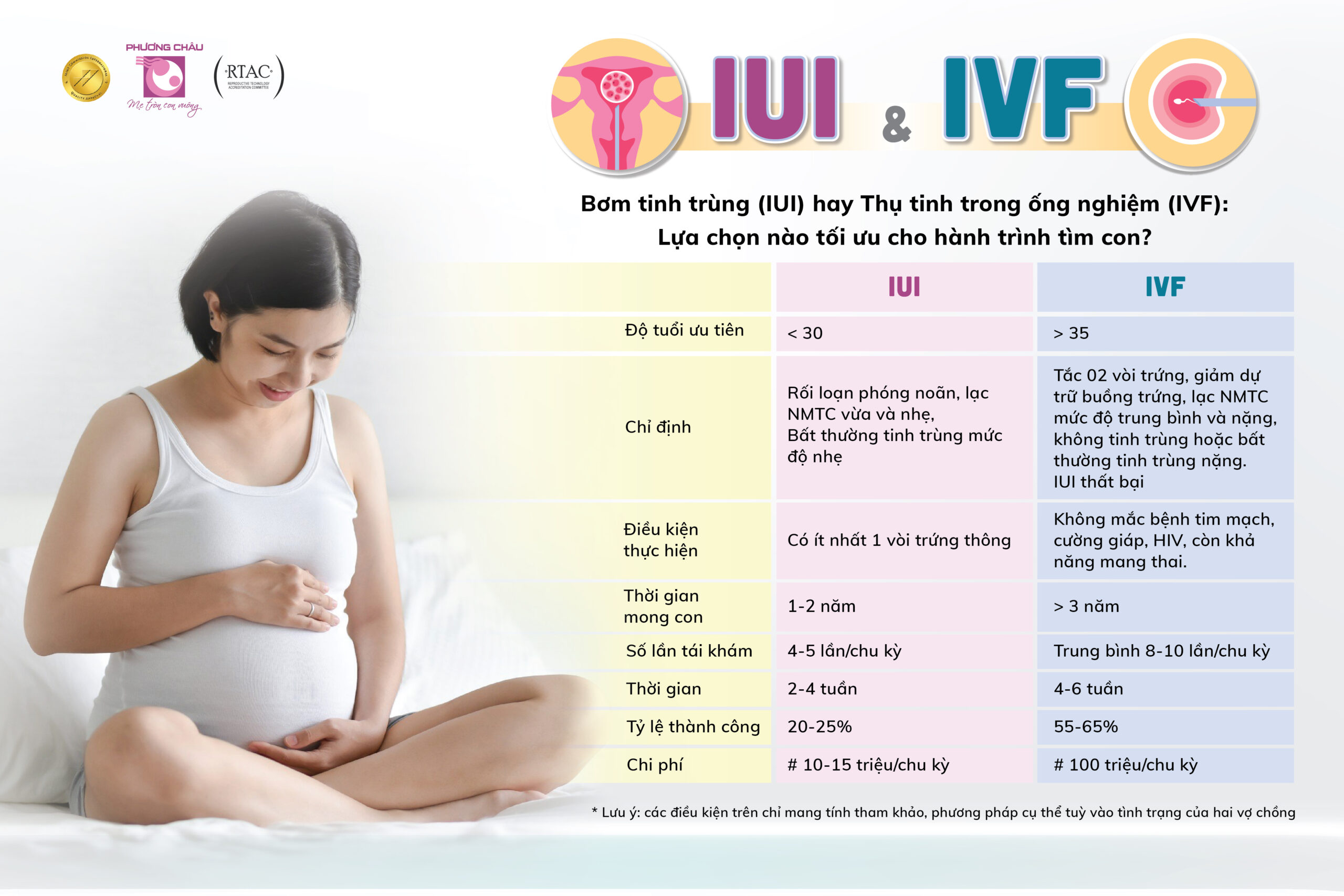
What is the difference between IUI and IVF?

In IUI, sperm are placed directly into the uterus so fertilization can occur inside the body. IUI is typically used in less complex cases of infertility.

In IVF (in vitro fertilization), eggs are fertilized with sperm in a laboratory to create embryos. An embryo is then transferred to the uterus. IVF is typically used in more complex cases of infertility.

How much does IUI cost?

Considering IUI?

Book a consultation to have your fertility assessed and develop a treatment plan tailored to you.

Success Stories

Hệ thống IVF Phương Châu
From the U.S. to Vietnam to Start a Family
Read the story
Hệ thống IVF Phương Châu
Welcoming a Baby at IVF Phuong Chau Sai Gon
Read the story
Hệ thống IVF Phương Châu
03
A Couple Welcomes a Baby After More Than 10 Years of Waiting, Following Azoospermia and an Ectopic Pregnancy
Read the story

Related Articles

Hệ thống IVF Phương Châu
IUI or IVF: Which Fertility Treatment Is Right for You?
Read the article
Hệ thống IVF Phương Châu
Managing Stress During IVF and IUI
Read the article
Hệ thống IVF Phương Châu
Tips for a Second or Third Cycle of IVF or IUI
Read the article

References

Zippl AL, Wachter A, Rockenschaub P, Toth B, Seeber B. Predicting success of intrauterine insemination using a clinically based scoring system. Arch Gynecol Obstet. 2022 Nov;306(5):1777-1786. doi: 10.1007/s00404-022-06758-z. Epub 2022 Sep 7. PMID: 36069921; PMCID: PMC9519724.